
A flashing light in the rearview mirror, a disputed stop order, or a short attempt to reach a safe place can become part of a Florida fleeing-or-eluding investigation. The accusation itself does not answer what the driver saw, heard, understood, or did. The exact subsection charged and the full sequence of events matter.
Florida Statutes section 316.1935 covers several forms of fleeing or attempting to elude a law enforcement officer, including aggravated versions. The statute sets out different requirements for those offenses, so the facts needed for one subsection may not be identical to another. The current text is available from the Florida Senate’s 2026 statute page.
What the basic offense requires
Under subsection (1), the state must address whether the person was operating a vehicle, whether a duly authorized law enforcement officer ordered the vehicle to stop, whether the driver knew of that order, and whether the driver willfully failed or refused to stop—or, after stopping in knowing compliance, willfully fled in an attempt to elude. The precise charge and controlling jury instructions should be reviewed in the actual case.
Knowledge and intent are not established by the mere fact that a vehicle continued moving. A driver may not have perceived a signal, may have been trying to reach a safe stopping location, or may have understood an event differently. Those possibilities are not automatic defenses; they are examples of factual questions that have to be assessed against the evidence.
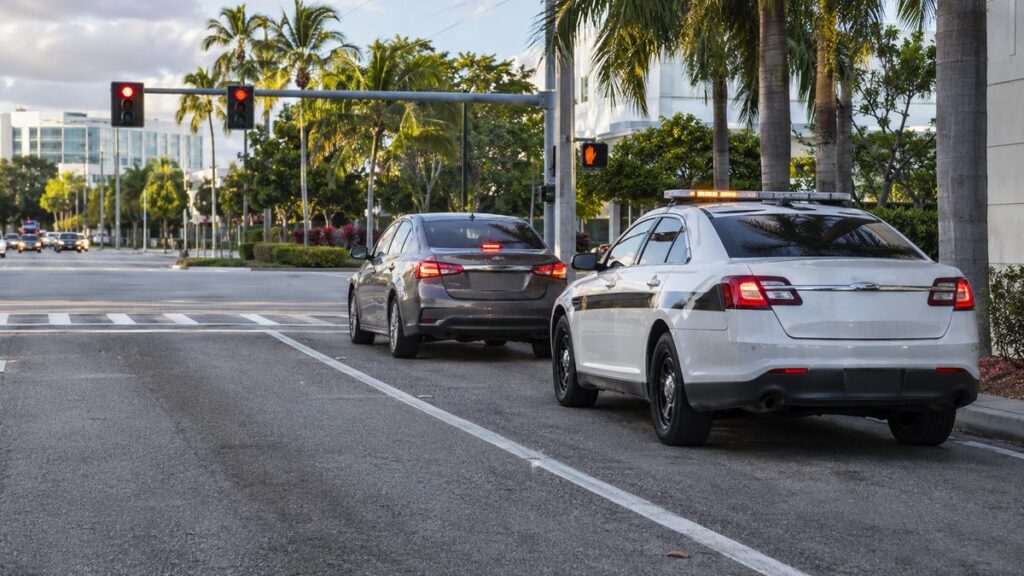
Why the subsection matters
Other parts of section 316.1935 address additional circumstances. For example, subsections (2) and (3) specify conditions involving an authorized patrol vehicle, prominent agency markings, and activated lights and siren. Subsection (3) then addresses driving at high speed or in a manner demonstrating wanton disregard for safety, with a more serious classification when serious bodily injury or death results. Subsection (4) concerns fleeing in the course of unlawfully leaving a crash scene and includes separate injury and damage provisions.
Because these are different statutory paths, it is important to identify the exact subsection and the conduct the charging document alleges. A news description, booking label, or shorthand account may not tell the whole story.
Records that may help establish the sequence
A careful review may include dash-camera and body-camera video, dispatch audio, computer-aided dispatch timestamps, the patrol vehicle’s lights and siren records, location data, roadway cameras, traffic conditions, and witness accounts. These materials can help show when an order was given, what signals were active, where the vehicles were, and how long events took.
Video should be viewed in context. A short clip may begin after the initial signal or end before the vehicle stops. Different camera angles can have different timestamps or fields of view. Preserving the original files and noting the source and approximate time can help counsel identify what should be requested through the appropriate process.

Potential license and vehicle consequences
Section 316.1935 provides for a driver’s-license revocation of one to five years for a conviction under subsections (1) through (4). It also contains restrictions on suspending, deferring, or withholding adjudication or sentence for a violation of the section. Certain aggravated forms carry more serious felony classifications, and the statute specifies a three-year mandatory minimum for particular convictions involving serious bodily injury or death. The exact consequences depend on the charged subsection, the allegations, and applicable law.
The statute also treats a vehicle involved in a violation as contraband subject to seizure and forfeiture procedures. That provision makes it especially important not to assume the only issue is a traffic citation or court date. A lawyer can explain which provisions are actually implicated in a particular case.
Practical steps after an allegation
- Keep the citation, arrest paperwork, release documents, and all court notices together.
- Write down a private timeline of the route, signals noticed, stops made, traffic, and where the vehicle came to rest.
- Preserve any vehicle camera footage, phone location information, photos, and messages in their original form.
- Do not edit or delete potential evidence, post a public explanation, or contact witnesses to coordinate accounts.
- Check every court date and release condition, and ask counsel promptly about preserving government or private video that may be overwritten.
These are general preservation steps, not a substitute for advice about what to say or do in a specific investigation. If law enforcement requests an interview, get case-specific legal advice before deciding how to respond.
How this can relate to other traffic allegations
A fleeing-or-eluding allegation can arise alongside a crash-related charge, a traffic offense, or another criminal count. Each charge has its own elements and evidence. The firm represents clients in DUI and traffic-defense matters; that page provides information about the firm’s broader traffic practice. For a case-specific discussion, use the firm’s contact page.
Common questions
Does a driver have to reach a certain speed for every fleeing charge?
No. Speed and dangerous driving are part of specified aggravated provisions, but the basic subsection has different elements. The charge must be reviewed under the exact subsection cited.
Does stopping eventually automatically resolve the allegation?
No. The statute addresses both failing to stop and, in some circumstances, willfully fleeing after first stopping. The sequence and the driver’s knowledge and conduct need to be assessed from the evidence.
Can a license be affected even if there was no crash?
Yes. Section 316.1935 includes a one-to-five-year license-revocation provision for convictions under subsections (1) through (4). The specific legal consequences depend on the charge and outcome.
This article is general legal information, not legal advice. It does not create an attorney-client relationship or predict the result of any matter. Florida law can change, and its application depends on the exact charge and facts.